
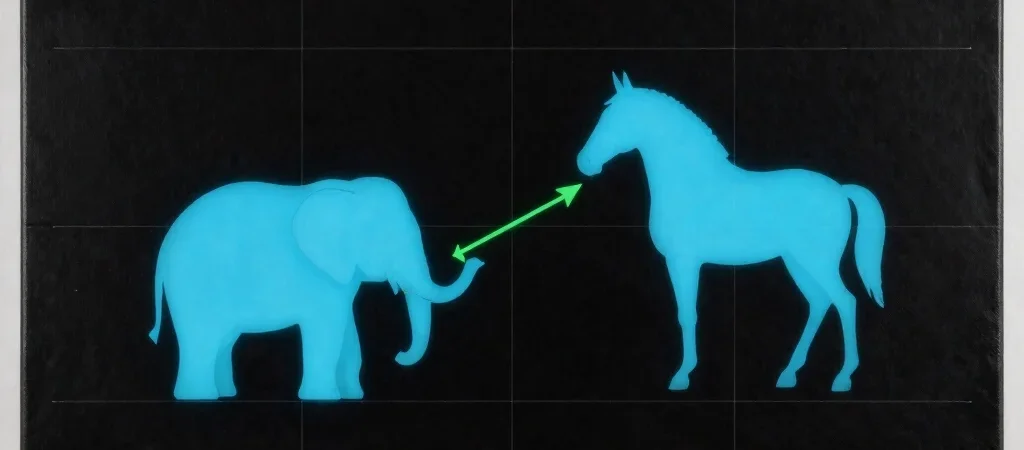
Take the proposed difference Δβ = v(Elephant) − v(Horse). It points from the horse representation toward the elephant representation in semantic embedding space, giving the model a candidate direction to examine. The key word is candidate: a vector difference describes a geometric relation, not a successful prediction.
A direction between representations
Here, v(Elephant) and v(Horse) stand for semantic representations, and subtracting one from the other produces Δβ. If those representations encode useful relationships, the difference may capture a direction that can be applied when reasoning beyond the examples used to define it. The supplied formulation does not specify how the embeddings are constructed or establish what properties their geometry has.
Extrapolation needs a premise
Using Δβ to move toward an unseen class depends on the assumption that the direction remains meaningful in the relevant region of the space. That is the theoretical appeal of vector-difference maneuvers: they offer an explicit path for expressing a semantic transition without a training example for the target class. The path is a hypothesis about the representation, not a guarantee that the destination corresponds to a recognizable class.
Geometry is not validation
A diagram can make the vector look persuasive while leaving the central question unanswered: does applying that direction predict the unseen class? The elephant-minus-horse example illustrates the proposed operation, but the supplied material gives no performance results to settle that question. Treat the vector as a reasoned construction to test, not as evidence of zero-shot accuracy.